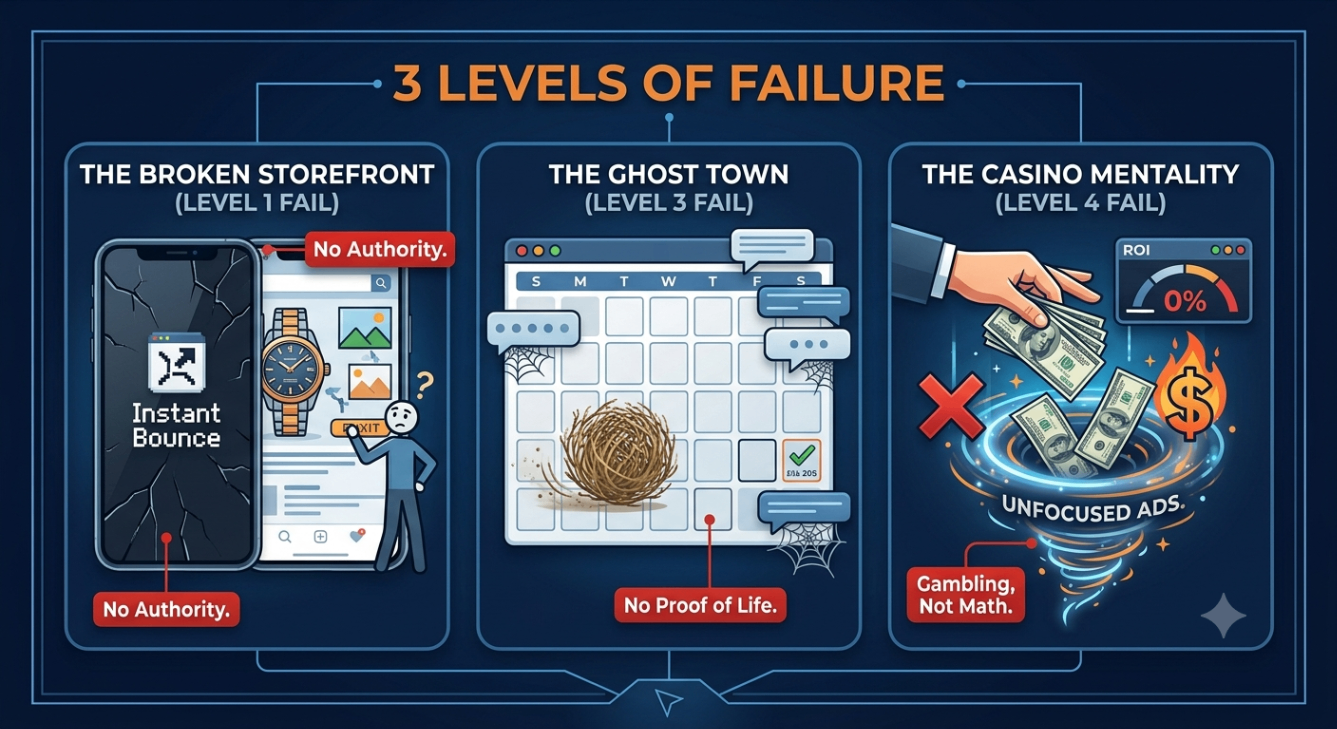
You’re in the right place if advertising feels like a tiny slot machine.
You put in $50. Then another $100. You refresh the dashboard. A few clicks appear. Maybe one lead comes through. Maybe nothing happens. By the time you reach $500, you’re wondering whether ads work at all.
Here’s the honest answer: ads can work. But throwing $500 at them without knowing your numbers is not a strategy. It’s a bet.
At Buzz Ur Brand, we call this the casino mentality. It happens when businesses spend with hope instead of a clear understanding of what a customer is worth, what acquisition can cost, and how long the campaign needs to run before the data becomes useful.
The solution is simple, practical, and surprisingly comforting: spend with math, not hope.
Advertising Should Feel Like a Plan, Not a Slot Machine
Entrepreneurs, creatives, healthcare practices, nonprofits, and community builders all face the same pressure. You want more visibility, more calls, more bookings, and more customers.
But every dollar matters.
When your budget is limited, you cannot afford to ask, “What happens if we try ads?” A better question is:
“What does this campaign need to accomplish for the investment to make financial sense?”
That question turns advertising from an emotional gamble into a measurable experiment.
A successful campaign does not always produce immediate profit. It may first teach you which audience responds, which message earns attention, or which landing page needs work. That learning has value. But you need a framework to measure it.
This is the purpose of Ad Math, Pillar 4 of The Ecosystem Engine. We calculate what a customer is worth, determine what you can afford to spend, structure the budget, and track the results from the first dollar.
Step One: Know Your Customer Acquisition Cost
Your Customer Acquisition Cost, or CAC, tells you how much it costs to acquire one new customer.
The basic formula is:
CAC = Total sales and marketing costs ÷ Number of new customers
For a simple campaign, you may start with:
CAC = Ad spend ÷ New customers
But a more accurate CAC can include:
- Advertising spend
- Creative production
- Landing page or website costs
- Marketing software
- Agency or contractor fees
- Sales time and follow-up costs
If you spend $500 and gain five customers, your basic CAC is $100.
That number alone does not tell you whether the campaign is good or bad. A $100 CAC might be excellent for a customer worth $2,000. It might be disastrous for a product that produces only $60 in gross profit.
The number needs a partner.
Step Two: Calculate Customer Lifetime Value
Customer Lifetime Value, or LTV, estimates the total value a customer creates during their relationship with your business.
For a subscription or repeat-service business, a simplified formula is:
LTV = Average revenue per customer × Gross margin × Average customer lifetime
For a transactional business, you might use:
LTV = Average order value × Purchase frequency × Gross margin
The important detail is gross margin. Revenue is not the same as profit.
Imagine a wellness practice earns an average of $1,200 from a client over time. After direct service costs, payment processing, and delivery expenses, the practice keeps a 60% gross margin.
The estimated lifetime gross profit is:
$1,200 × 60% = $720 LTV
That $720 is the useful figure for acquisition planning. It shows how much economic room exists to acquire the client while still supporting the business.
If you want a deeper explanation of the relationship between lifetime value and acquisition cost, Wall Street Prep’s LTV:CAC overview provides a helpful financial breakdown.
Step Three: Set Your Maximum Acceptable CAC
Now we connect the two numbers.
A common sustainability target is a 3:1 LTV-to-CAC ratio. In plain English, you want approximately $3 in lifetime gross profit for every $1 spent acquiring a customer.
The formula is:
Maximum CAC = LTV ÷ Target LTV:CAC ratio
Using the example above:
$720 LTV ÷ 3 = $240 maximum CAC
That means the practice can spend up to $240 to acquire a client and still remain within its target ratio.
Now the $500 budget has a job.
$500 ÷ $240 = 2.08
The campaign needs to acquire at least three clients to move beyond the maximum CAC threshold.
Without this calculation, the business might celebrate a few leads without knowing whether those leads can become profitable customers.
With it, everyone understands the assignment.
The $500 Test: Structure It Before You Spend It
A $500 budget is not automatically too small. It is simply too small for vague expectations.
Before launch, define:
- The offer being promoted
- The audience you want to reach
- The conversion event you are measuring
- Your maximum acceptable CAC
- The number of customers or qualified leads required
- The time period for the test
- The decision you will make after the test
For example:
- Budget: $500
- Maximum CAC: $50
- Required customers: 10
- Required landing-page conversion rate: based on expected click costs
- Test period: long enough to collect meaningful data
You can work backward from the customer goal.
If your expected cost per click is $2, a $500 budget may produce approximately 250 clicks. If your website converts 4% of those visitors, you may generate about 10 leads or customers, depending on the funnel.
That is where the math becomes a conversation starter. If 10 customers are required but your current website converts only 1%, the problem may not be the ad. It may be the storefront.
Your Website Conversion pillar helps make sure paid traffic arrives somewhere clear, credible, and ready to welcome people in.
Budget Structure Matters More Than Most Businesses Think
Many businesses set ad budgets by looking at whatever money remains at the end of the month.
That is understandable. It is also risky.
A stronger structure separates the budget into purposeful categories:
✅ Testing budget: Used to compare audiences, offers, and creative angles.
✅ Learning budget: Reserved for gathering enough data to identify patterns.
✅ Scaling budget: Used only after the campaign demonstrates acceptable performance.
✅ Optimization reserve: Held back for landing-page updates, creative refreshes, or follow-up improvements.
This approach prevents one weak ad from consuming the entire budget. It also avoids the opposite mistake: changing everything too quickly.
A campaign needs enough time and volume to reveal useful information. Most businesses pull the plug right before a campaign proves itself: not because every campaign deserves unlimited patience, but because they launch without defining what “enough data” looks like.
Build Tracking Before You Build Excitement
Good advertising is not just an attractive image and a clever caption.
It is a connected path:
Ad → Landing page → Lead or purchase → Follow-up → Customer → Revenue
Every step should be trackable.
At minimum, monitor:
- Impressions
- Click-through rate
- Cost per click
- Landing-page visits
- Leads or inquiries
- Booked calls or appointments
- New customers
- Revenue
- CAC
- Return on ad spend
Your tracking should answer one simple question:
“Which dollars created meaningful action?”
Use campaign-specific links, conversion tracking, forms, booking data, and customer records. If a campaign generates leads but nobody follows up, the ad may not be the problem. If people click but leave immediately, the page may need attention.
Your Search Dominance and Organic Pulse also support this ecosystem. Paid ads work best when your broader presence reinforces trust instead of leaving prospects in an empty digital room.

Use a Clear Optimization Cadence
“Set it and forget it” is a great strategy for leftovers in the refrigerator. It is not a great strategy for advertising.
A practical optimization rhythm looks like this:
Every one to three days
Check for technical problems and delivery issues:
- Is the campaign spending correctly?
- Are links working?
- Are impressions and clicks arriving?
- Is the cost per click unusually high?
- Are comments or messages revealing confusion?
Weekly
Review performance by campaign, audience, ad, and landing page:
- Which creative earns attention?
- Which audience produces qualified action?
- What is the current CAC?
- Is CAC below your maximum acceptable level?
- Are leads turning into conversations or customers?
Monthly or by customer cohort
Update the deeper business numbers:
- Actual customer retention
- Repeat purchases
- Upsells
- Realized gross margin
- Payback period
- Updated LTV
The goal is not to obsess over every tiny movement. The goal is to create a steady feedback loop that helps you improve with confidence.

Remember: CAC Is Not the Whole Story
A campaign with a high initial CAC may still become valuable if customers return, renew, refer others, or purchase additional services.
A campaign with a low CAC may still be unhealthy if it attracts poor-fit customers who consume time, request refunds, or never return.
That is why we look beyond surface-level metrics.
You need to understand:
- What customers cost to acquire
- What customers contribute over time
- How quickly you recover the acquisition cost
- Whether the customer relationship supports your mission and capacity
For a community organization, success may include event registrations, recurring donors, or deeper participation. For a therapist, it may mean appropriate inquiries and consistent appointments. For a creative business, it may mean repeat projects and referrals.
The math changes by business. The need for math does not.
Stop Spending With Hope. Start Spending With Math.
The calculator is not here to drain the creativity from marketing. It protects your creativity.
When you know your numbers, you can make room for stronger ideas. You can test a bold message without confusing boldness with recklessness. You can decide when to refine, when to pause, and when to scale.
That is the heart of Buzz Ur Brand’s Ecosystem Engine: a connected marketing system where Website Conversion, Search Dominance, Organic Pulse, and Ad Math all report back to the same set of numbers.
Your brand should feel like home: warm, authentic, and unforgettable. Your advertising should make that home easier for the right people to find.
So before you spend $500, calculate your LTV. Set your maximum CAC. Define your test. Build your tracking. Choose your optimization cadence.
Then spend with math, not hope.
Ready to see whether your advertising system is built for sustainable growth? Book a consultation with Buzz Ur Brand, and let’s build something unforgettable together.
Leave a Reply